


Based in San Francisco for the past ten years, Virginie Personne founded Petits Pas Studio, a school that blends dance, theater, artistic excellence, and a strong sense of community. A former pediatric physician, medical lecturer in Paris, and professional dancer, she reinvented her life in California around three pillars: family, education, and dance. On the occasion of the studio’s tenth anniversary, she reflects with MerciSF on this unique journey, the values that drive her, and the beautiful collective adventure that began almost instinctively.
How did Petits Pas come to life when you arrived in San Francisco?
When I arrived ten years ago, I came from Paris with a rich background: physician, university lecturer, researcher… and dancer. With two young children and an intense life behind me, I felt the need to slow down and refocus my life around my family.
But very quickly, I realized I also needed a project to anchor myself here. Petits Pas was not born from market research, but from a deeply personal need: to re-root myself in a new country.
Through this studio, I sought to recreate an environment that reflects who I am — human, structured, warm, with a European sensibility. Dance (and more broadly, creation) became that anchor point.
What was the original philosophy behind Petits Pas?
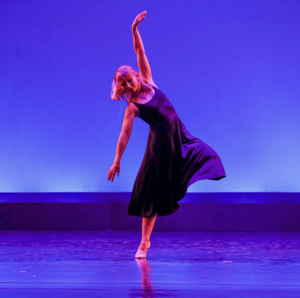 When I arrived in San Francisco, I was struck by the number of studios and “drop-in” classes. That flexibility didn’t really match my vision: for me, dance is a commitment built over time.
From the start, I wanted to create a sense of community. That was essential. I immediately felt the strength of the collective here, and I wanted to offer that through the studio.
But it wasn’t just about building connections. I also wanted to convey a certain level of rigor. For me, pleasure and freedom come through technique. The goal was never to “just have fun,” but to strive for something we can be proud of.
What French influences shape your studio and your teaching style?
There is, of course, rigor and a strong relationship to transmission. But there is also the language: ballet vocabulary is French, and I always find it delightful to hear my young American students say “plié” or “arabesque.”
More deeply, there is also a certain idea of inner discipline. Not authoritarian strictness, but a state of presence, focus, and respect for both the group and oneself. That’s something I try to pass on.
Looking back, what are you most proud of today?
First, there is a personal pride: having managed to bounce back, to change my life, to reinvent myself. I like the idea that we can have several lives.
But there is also immense artistic pride. The performances we create with my partner Marie Walburg are true artistic productions and collective projects. The whole team, the students (more than 200 today), the families — everyone is moving in the same direction. And over the years, I believe we’ve developed a very distinctive signature.
What exactly is this signature that defines Petits Pas?
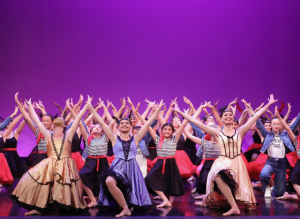 We don’t simply create a dance performance, nor just a theater play. We write a complete story from beginning to end, with a real narrative thread. Dance and theater interact, complement, and enrich one another.
This format allows us to explore a wide range of emotions, from sensitive to burlesque, from poetic to comedic. This blend is truly our identity. Artistically, it is incredibly rich.
You also talk a lot about transformation. Why is this word so important to you?
Because it’s exactly what the stage allows. Dance transforms. And what deeply moves me is seeing students — both children and adults — discover another side of themselves.
At the end of performances, I often see a very strong emotion in the eyes of loved ones. As if they were discovering someone they already knew… but differently. It’s beautiful.
With adults, it can be even more powerful, because they often come with very fixed ideas about themselves: “I’m not graceful enough,” “this isn’t for me,” “I’ll never go on stage.” And then all of that falls away. They rediscover themselves.
Do adults have a real place in the studio?
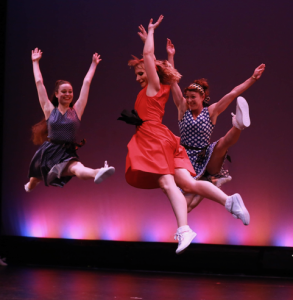 Yes, absolutely. And it was one of my core beliefs from the start. I wanted everyone to be able to go on stage. At first, most adults almost refused. They would say, “The stage is for children or real dancers.”
Today, it’s almost the opposite: some come specifically because they want to experience it. It has become a goal, a personal challenge, sometimes even a revelation.
Do you have any memorable student journeys in mind?
Yes, many. For example, one adult who was among my very first students. She arrived at a time of major questioning in her life. Today, she dances a lot, in several studios, and dance has truly changed something for her.
There are also children I’ve seen grow up since the beginning who later joined excellent programs, such as the San Francisco Ballet School or the dance department at SOTA. Watching these paths unfold is a huge joy.
Is one of Petits Pas’ greatest successes also the community built around it?
Yes, without hesitation. It’s one of the most moving aspects for me. Today, the Petits Pas community exists on its own. Students meet outside of classes, go to performances together, exchange ideas, organize themselves.
When I see something living beyond the studio, when real connections have formed, I feel that the mission has been accomplished.
How will you celebrate Petits Pas’ tenth anniversary?
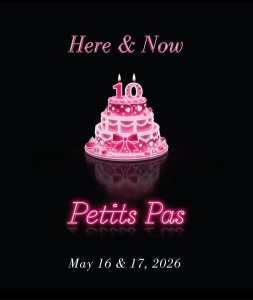 Obviously, we weren’t just going to put on a show and sing “Happy Birthday” at the end! We imagined a real storyline around a birthday dinner, true to our love of storytelling and staging.
We will bring back characters from previous years, who will meet, interact, sometimes in very funny ways. There will be nods to the past, but never as simple repeats. I don’t like “reheating old dishes.” This celebration had to be a new artistic creation.
Does this anniversary performance also reflect the family spirit of the project?
Yes, completely. Petits Pas is a very family-driven adventure. My loved ones participate in different ways, and that’s very important to me. In our productions, we like to blend multiple art forms: dance, theater, live music, videography, prop-making…
We do a lot of things ourselves, by hand, as a family and as a team. It’s a lot of work, but it’s also what gives the studio its unique texture.
What have been the biggest challenges over the past ten years?
Covid, without hesitation. It was an extremely difficult time, but also very revealing of the strength of our community. We kept going no matter what: outdoors, on basketball courts, sometimes in improbable conditions.
With the team, we did everything we could to keep the studio alive. And when we were able to resume, everyone came back. It strengthened something very powerful between us.
How do you envision the future of Petits Pas?
I don’t want to grow the studio at all costs. I don’t want to turn it into a machine. What I want to preserve is the human dimension, the connection, the personalization.
Artistically, I would like to continue developing certain ideas, perhaps further distinguishing the theater and dance components, while preserving our shared signature.
With my artistic partner Marie, we are also thinking about extending some creations into other formats, such as short films for festivals.
And your ultimate dream?
The ultimate dream would be to one day have a small company of professional dancers alongside the school. Not to replace what we do with amateurs, which I deeply love, but to create a dialogue between training, transmission, and professional creation. That would be a very inspiring next step.
“Here & Now” Recital
📅 Saturday May 16 at 3:00 PM and Sunday May 17 at 12:00 PM
📍 Location: Brava Theater, San Francisco
🎟️ Tickets here


