


Olivier Goy Has No Time to Lose — and He Wants to Change the Future of Neurological Research
Writing about a meeting with Olivier Goy in a professional setting quickly becomes something much more personal. With his radiant smile, intact sense of humor, and luminous presence, the French entrepreneur forces each of us to confront a question we often prefer to postpone: what would we do if time suddenly became our most precious resource?
We met him twice during his exceptional visit to the Bay Area: first at a conference organized by FrenchFounders in San Francisco, and then at the Consulate General of France, where a meeting with researchers, philanthropists, and members of the scientific committee of Paris Brain Institute America was also held.
Diagnosed with Charcot disease, also known as ALS, in 2020, Olivier Goy can no longer speak and now uses a wheelchair. And yet, throughout several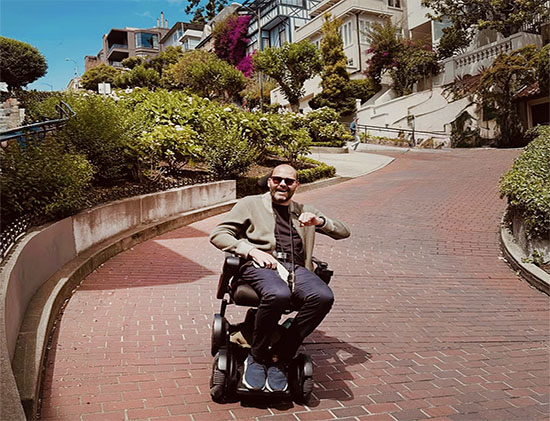 days in Silicon Valley, he was the one to set the tone: one of optimism, action, and unwavering confidence in research.
Founder of 123 Investment Managers and the crowdfunding platform October, Olivier Goy long embodied a certain vision of entrepreneurial success. A life lived at full speed, driven by investments, fundraising, and growth.
Then everything changed.
“Before, I wanted to succeed. Today, I want to be just.”
That sentence alone sums up the transformation that has taken place since his diagnosis. A transformation that is anything but a surrender. Quite the opposite.
In San Francisco, Olivier Goy came to champion an ambitious project: Invincible Hope, an initiative designed to accelerate research on neurodegenerative diseases by mobilizing researchers, entrepreneurs, philanthropists, and technology leaders.
During his stay, he multiplied meetings and conversations: a visit to Neuralink, exchanges with teams from Meta, Google DeepMind, and Playground VC, a stop at Stanford, an appearance on Carlos Diaz’s Silicon Carne podcast, a dinner organized by Marc Menasé’s Founders Future, meetings at the French Consulate, and events with FrenchFounders. It was a true awareness and mobilization tour aimed at building bridges between the French research ecosystem and American innovation leaders.
At the heart of this mobilization is the Paris Brain Institute and its American branch, Paris Brain Institute America.
Based in New York, Martine Assouline, co-founder of the renowned publishing house Assouline and President of Paris Brain Institute America, created the American foundation to help the Paris Brain Institute expand its presence across the Atlantic and facilitate the funding of Franco-American research projects.
“We want to create more and more bridges between France and the United States,” she explains. “Today, researchers are working together between Paris, Harvard, Columbia, Mount Sinai, and many other international partners. Brain research must be global.”
Drawn to the unique model of the Paris Brain Institute, which brings together researchers, clinicians, and patients in one place to accelerate scientific discoveries, she now devotes a significant part of her time to developing international collaborations and mobilizing philanthropists and donors around an issue that concerns us all.
One of the major announcements of this visit focused on the development of a new collaboration between the Paris Brain Institute and Mount Sinai in New York around artificial intelligence and large-scale medical data analysis. The goal: to build a cohort of 100,000 patients in order to accelerate the understanding of neurological diseases and the development of future treatments.
For Olivier Goy, artificial intelligence represents an unprecedented accelerator.
“We have the data. We did not have the eyes to read it.”
That is how he describes the billions of pieces of information generated by MRIs, genetics, and biomarkers. According to him, AI could make it possible to accomplish in five years what previously required several decades of research.
Technology also plays an essential role in his own daily life.
During the conference, his voice was generated through Invincible Voice, an artificial intelligence system developed from just a few seconds of recording made before he lost his speech. The open-source technology can recreate his voice and allow him to converse almost in real time.
“Artificial intelligence did not invent my voice. It gave it back to me.”
But perhaps the most striking aspect of his visit to California was his ability to bring people together.
With his wife Virginie, his son Clément, the Paris Brain Institute America team, and many volunteers, Olivier Goy is also leading La Fresque Généreuse, a monumental artistic project composed of thousands of portraits designed to fund neurological research.
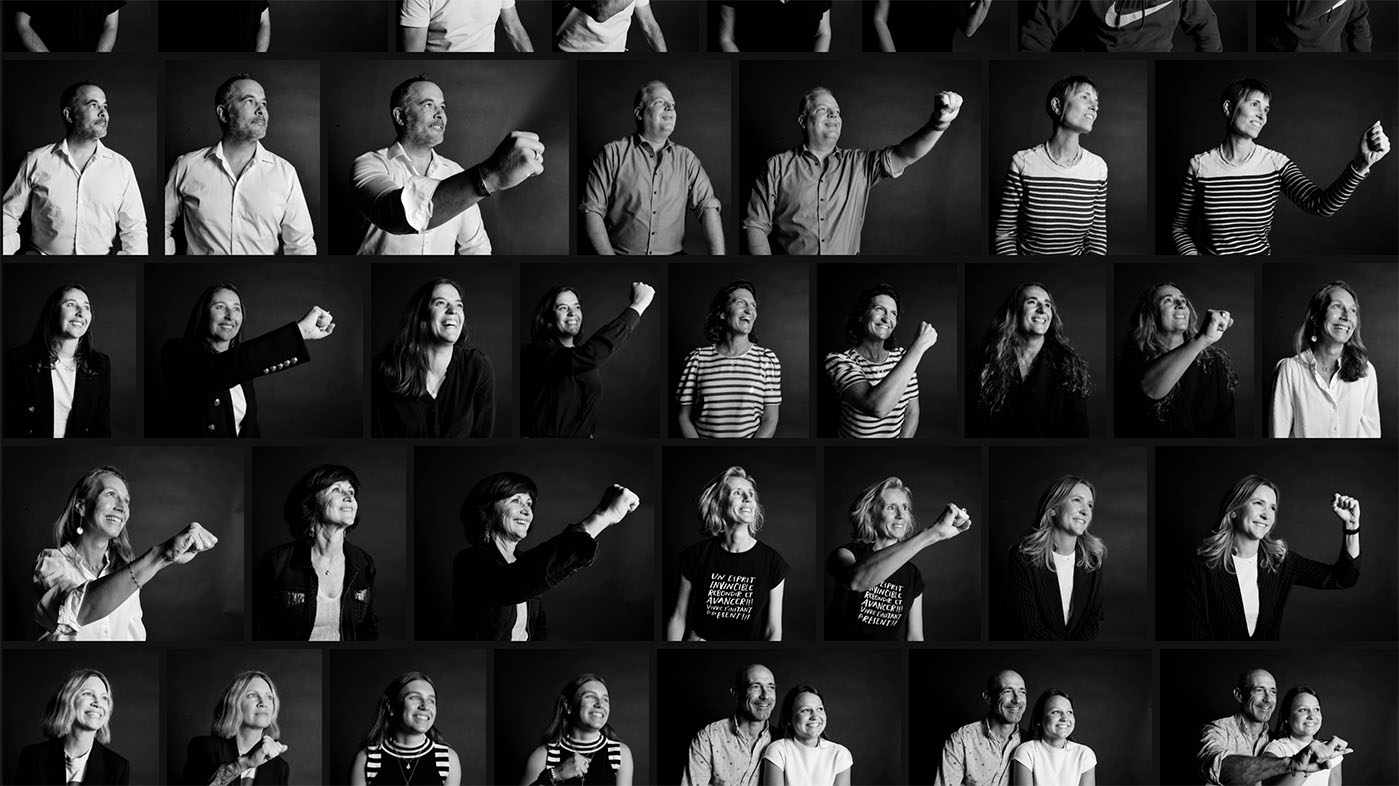
In San Francisco, several photo sessions were organized with the French and Francophile community. Each portrait contributes to funding research. The goal is simple: to turn faces into a collective movement capable of advancing science.
This mobilization is already bearing fruit. According to the organizers, more than $522,000 was raised during this American visit to support neuroscience research.
For Martine Assouline, the issue goes far beyond philanthropy.
“More than one in three people will be affected by a brain disease in their lifetime, directly or indirectly.”
It is a figure that explains the urgency of the mobilization. Today, neurological diseases already represent a massive cost for European and American healthcare systems, a cost that will only continue to rise as populations age. For the President of Paris Brain Institute America, supporting research is no longer simply an act of generosity: it is a collective investment in our future.
Throughout his remarks, Olivier Goy returned to one idea that now seems to guide each of his projects: fragility is not the opposite of strength.
“Strength builds companies. Fragility builds movements.”
In a Silicon Valley often obsessed with performance, speed, and optimization, the message resonates with particular force.
Olivier Goy presents himself neither as a victim nor as a hero. Rather, he appears as an entrepreneur who has decided to devote the time he has left to something larger than himself.
And that is probably what makes his presence so inspiring.
As the disease gradually reduces his physical abilities, he continues to expand his impact. No longer by building companies, but by bringing together researchers, investors, engineers, doctors, and donors around one shared conviction: hope is not a feeling. It is a collective project.
For Olivier Goy, time has become the rarest resource. But in San Francisco, he showed that he can still transform that urgency into hope, mobilization, and progress. A reminder that, when it comes to brain diseases, the future does not depend only on researchers or technology. It also depends on our collective ability to act, starting today.
Merci, Olivier Goy.
How to Support Invincible Hope
Those who wish to support research on neurodegenerative diseases can make a donation in the United States through Paris Brain Institute America:
parisbraininstitute-america.org
Donations are tax-deductible in the United States.
Donors in France can support the Paris Brain Institute directly:
institutducerveau.org
To take part in Olivier Goy’s Fresque Généreuse and contribute to the Invincible Hope project:
Join the Fresque Généreuse
After his visit to the Bay Area, the Invincible Hope campaign has already raised more than €540,000 for neurological research, demonstrating the remarkable mobilization of the French and American communities around a cause that concerns us all.


