


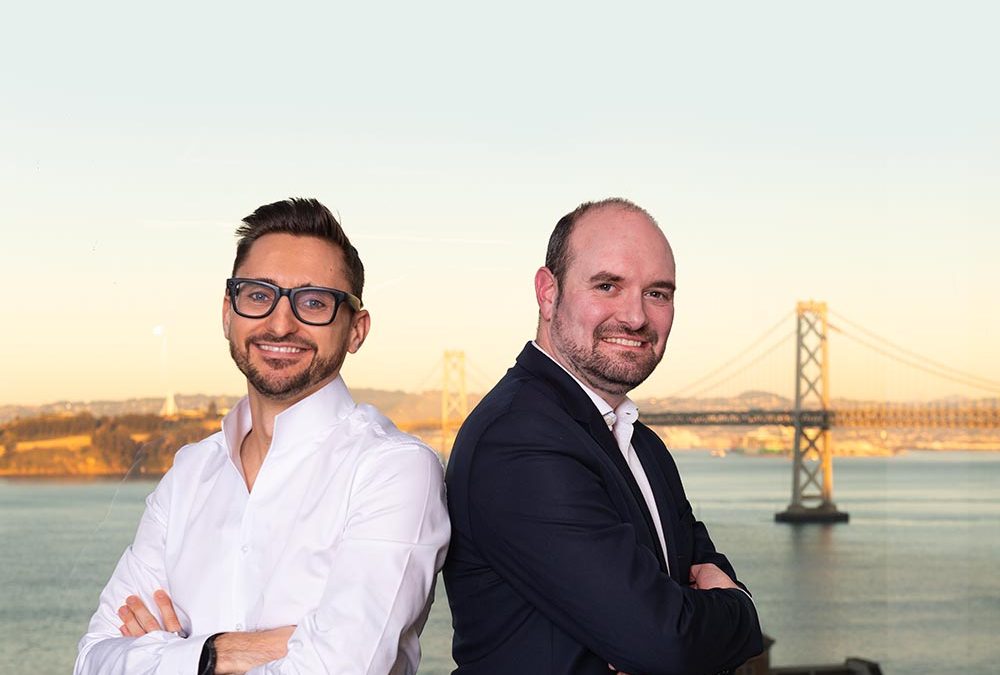
Matthieu Soulé and Arnaud Auger represent a new generation of experts at the intersection of venture capital, innovation, and high-impact investment. Today, as heads of C.Lab, the advisory service launched by Cathay Innovation*, a global fund investing in startups with a positive impact, they connect startups with major corporations and global markets while integrating sustainability and technological transformation challenges.
With a background shaped by their time at the BNP Paribas Innovation Lab in San Francisco, Matthieu and Arnaud have gained a deep understanding of the dynamics between Europe and Silicon Valley, as well as expertise in the region’s tech ecosystem.
Key players in the French-American Bay Area community, Matthieu and Arnaud wear multiple hats: Matthieu as co-chair of the Mobility Committee at the FACC California SF-LA, mentor for organizations such as the Sustainable Ocean Alliance, and co-host of the climate tech community My Climate Journey (MCJ) in San Francisco; and Arnaud as co-chair of the Health Committee at FACC California SF-LA, mentor at the Plug and Play Startup Center, founder of the French National Team Fan Club in SF, and a regular guest on the Silicon Carne podcast.
In this interview, Matthieu and Arnaud reflect on their journeys, their vision for venture capital, and their commitment to impactful innovations.
*Founded in Paris in 2015, Cathay Innovation manages over 2.5 billion euros in assets and has invested in more than 100 high-growth startups, including Chime, Pinduoduo, Glovo, Wallbox, Ledger, and Owkin.
What brought both of you to San Francisco and to work at BNP Paribas’ Innovation Lab?
Matthieu Soulé: The first time I came to San Francisco was in 2008 for an internship at L’Atelier BNP Paribas. The experience went well, and I returned as a VIE (International Corporate Volunteer) in 2010 for a year, still at L’Atelier BNP Paribas. I then spent four years in Paris, from 2011 to 2014, before returning more permanently in January 2015.
L’Atelier BNP Paribas US was created in 2005 to understand technological advancements. Initially, we were mainly in contact with large companies like Cisco and HP, but over time, startups became more prominent. The idea was to get closer to technological innovation, understand new business models, and advise BNP Paribas and its corporate clients.
Arnaud Auger: I arrived in 2015 to work for a foodtech startup called Handpick. It so happened that this startup had been identified by L’Atelier BNP Paribas during a learning expedition organized for Danone and Carrefour. L’Atelier BNP Paribas acted as a bridge between startups and major corporations, between Europe and the U.S., and was looking for a profile like mine, with startup experience. Nathalie Doré offered me the opportunity to join them, and I seized the chance to be at this strategic intersection.
Before coming to San Francisco, I was in India, and even there, I realized that Silicon Valley determined the winners. For instance, between 2014 and 2016, Indian startups went from raising $1 billion to $9 billion due to investments from Silicon Valley. I understood that to stay in the game, I needed to be in San Francisco.
Was it the financial aspect that attracted you to BNP Paribas?
Arnaud Auger: Not exclusively. L’Atelier BNP Paribas was more of an innovation monitoring unit, far beyond financial services. As the largest bank in the European Union, BNP Paribas worked with many major European corporations. The goal was to understand how technology, particularly digital transformation, was reshaping industries and to anticipate its impact on financial services.
Can you give a concrete example?
Arnaud Auger: Yes, let’s take the example of mobility. The first time I took a ride in an autonomous car, I had a realization: in an Uber, you are in someone else’s space, whereas in an autonomous vehicle, you are alone. That changes everything. It makes the journey more personal. It reinforced my belief that individual car ownership in cities will become obsolete. In the future, I can see companies like Walmart having fleets of autonomous cars, allowing Americans to order a robot taxi to take them to the store and back home with their groceries.
Understanding these trends is crucial, including for BNP Paribas, which operates in auto loans, car leasing, auto insurance, and fleet management.
Can you explain the transition to C.Lab and Cathay Innovation?
Matthieu Soulé: Historically, our activity here was called L’Atelier BNP Paribas, but in 2020, it was renamed C.Lab. When we joined Cathay Innovation, we kept the name since it was already well known among our clients. C.Lab continues to support international corporations with their strategic challenges and new business models, and BNP Paribas remains one of our investors.
What is C.Lab’s current mission at Cathay Innovation?
Arnaud Auger: We launched C.Lab to continue helping large corporations understand innovation in San Francisco and connect with startups.
At Cathay Innovation, we continue to bridge France, Europe, and Silicon Valley, both for startups and large corporations.
My role is sometimes that of a translator: I translate the language of startups for corporates, and vice versa, adapting European realities to American trends.
How do you integrate artificial intelligence into your investments?
Arnaud Auger: AI is a strategic focus for us, particularly in healthcare, financial services, and energy. Cathay Innovation has invested in solutions for optimizing energy consumption, health data analysis, and financial modeling.
San Francisco is a hub for AI innovation, and we have seen renewed excitement since the rise of ChatGPT and OpenAI. This technological wave offers significant opportunities, and we intend to continue investing in this field.
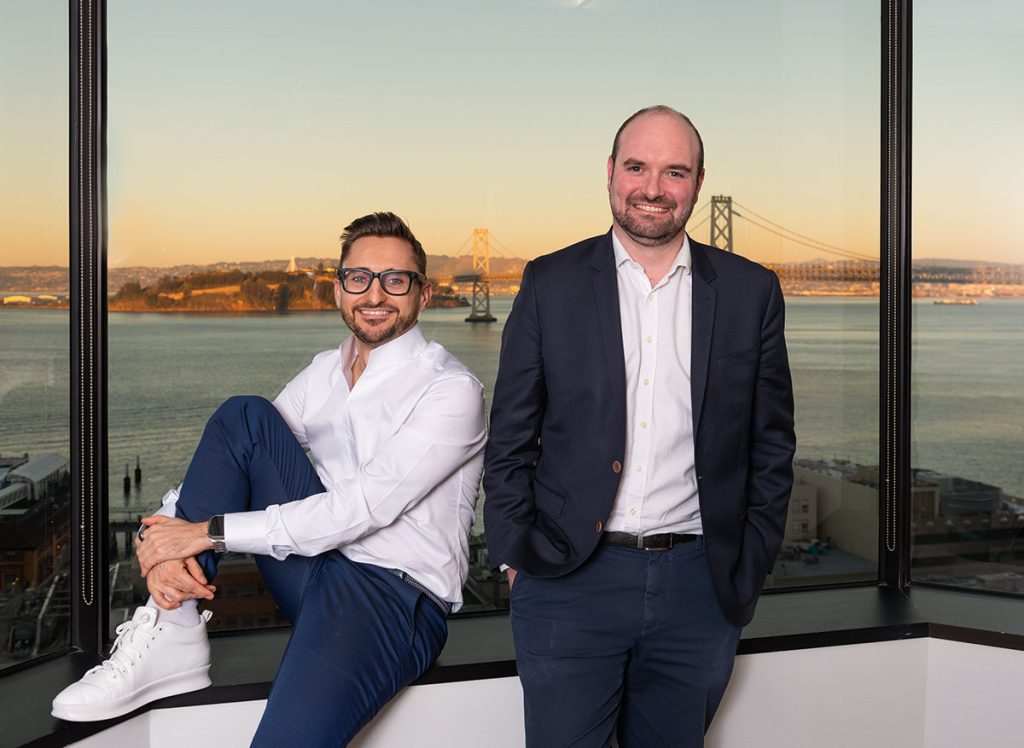
Arnaud Auger & Matthieu Soulé – Cathay Innovation in San Francisco
What is the added value of Cathay Innovation compared to traditional Silicon Valley funds?
Matthieu Soulé: There are two major differentiating factors.
- Our international reach: We have a global presence that allows us to connect players and ecosystems from different regions of the world.
- Our connection with corporates: Our startups can access large companies that invest in us. A good example is Owkin: after our investment, Sanofi, which had invested in Cathay Innovation, first became their client and then a direct investor in Owkin.
Most American funds are financed by pension funds and focus solely on financial returns. We provide large corporations investing in Cathay Innovation with a strategic network among startups and advisory services in innovation strategy.
Matthieu, you are very involved in sustainability. Can you tell us about the role of technology and innovation in addressing environmental challenges and mention startups or emerging technologies that stand out in this field?
The context is simple. We have historically worked with large European groups who, in their consulting requests, are increasingly questioning how to solve environmental challenges: renewable energy, vehicle electrification, alternatives to cowhide in luxury, and reducing methane emissions in agriculture. While addressing these topics, I became involved in various communities, particularly in biotech and climate tech.
Transport electrification is a key sector. For example, BNP Paribas Solar Impulse Venture Fund, where I am a Venture Partner, invested in 2024 in a startup called Chemix AI, based in Silicon Valley, which uses artificial intelligence to develop new batteries. Recently, Cathay Innovation also invested in David Energy in the U.S., which optimizes energy consumption for consumers and SMEs by adjusting their use of heating, air conditioning, and other appliances.
From a broader perspective, technology plays a crucial role in three areas:
- Developing new sources of green or low-carbon energy
- New technologies that help decarbonize various industries (chemicals, construction, steel, transportation…)
- Using artificial intelligence to optimize energy consumption, although some innovations (such as data centers) also create new energy demands.
In short, technology is an accelerator. While the term “climate tech” may evolve, the challenges of resilience and energy sovereignty remain critical, particularly in California and other parts of the world.
What are the key sectors where startups can have a significant impact?
Matthieu: We identify priority sectors for decarbonization based on the industries that emit the most greenhouse gases and where solutions exist to drive rapid change by deploying these technologies. Here are the main areas where solutions are actively being sought: low-carbon energy, transportation, heavy industries, construction, agriculture, and food.
In some of these sectors, we already know the technical solutions, and it’s just a matter of scaling up. For others, such as heavy industry or aviation, the technologies exist but are not yet mature or affordable. However, in the energy sector, we know that wind, solar, and geothermal work. We just need to accelerate their deployment.
Arnaud, could you tell us about your background and personal transformation, from struggling with health issues to becoming a high-performing athlete? How has this journey influenced your career and led you to your current role?
I believe my career has actually influenced my health. I have always been passionate about innovation and technology, which led me to study digital marketing, as the first web-based business models revolved around marketing and advertising. I also studied entrepreneurship, management, and innovation. My career started in digital marketing to stay at the forefront of technological advancements. I wrote the first book in French on Facebook marketing in 2011 and have been navigating this ecosystem ever since.
Five years ago, I was obese, prediabetic, with high cholesterol and poor cardiovascular health, despite my efforts to eat well and exercise. So, I adopted a key Silicon Valley principle: “You can only change what you measure.” I started tracking everything—DNA tests, gut microbiome analysis, blood tests—and used connected devices like the Withings scale and Oura ring, which helped me take control of my health.
Did you have any guidance during this transformation?
I took nutrition courses at Stanford and worked with a preventive and personalized medicine clinic. My doctor had real-time access to my health data, and so did I, through a dashboard tracking my sleep, activity levels, and more.
In your opinion, what is the future of healthcare?
I believe the future of healthcare is based on two pillars: precision and prevention. My DNA tests identified my predispositions to certain diseases, and today, epigenetic protocols exist to reduce those risks.
With increasingly precise diagnostics, technology can significantly enhance preventive healthcare.
People often call you a “biohacker.” How does this manifest in your daily life?
I have tailored my social media to only show content related to biohacking solutions. Just yesterday, I was talking to the CEO of a startup analyzing gut microbiome data, and he was surprised that I was one of the first buyers of his product. I love testing innovations ahead of the curve, which allows me to quickly identify those that can make a real difference.
You are both based in San Francisco. What are your favorite spots in the Bay Area?
Arnaud: My two favorite spots are Amélie and Paname. They are run by friends, Germain and Liam, and are among the best places to grab a drink. Amélie is probably the best wine bar in San Francisco, and Paname is a great spot to watch games, especially with the French community. Since I don’t drink alcohol, I asked them to add non-alcoholic options, and now they are on the menu! Paname is also the name of a new nightclub next to Petit Paris, another must-visit spot for the French community in San Francisco.
Matthieu: I really like a somewhat hidden park called Tank Hill Park. It’s like the “locals’ Twin Peaks,” located near Cole Valley. This place is special to me because it’s where I proposed to my wife. Many Americans take their fiancées to the Eiffel Tower—I chose this unique spot in San Francisco.
Thank you, Matthieu and Arnaud.


