


Born and raised in the Bay Area, Dylan Snyder has taken an unexpected path—from Marin Catholic High School to head coach of France’s national lacrosse team. MerciSF met with the French-American coach during a lacrosse clinic he ran for 5th graders at The International School of San Francisco. He shared his journey, his French roots, and the rise of lacrosse in France as the sport eyes its Olympic return in 2028.
MerciSF: Dylan, tell us about your background and how you first got into lacrosse.
Dylan Snyder: I was born in San Francisco and grew up in Marin County, where I discovered lacrosse at Marin Catholic High School. It was a new and fast-growing sport in the Bay Area back then. I later played at Whitman College, serving twice as team captain, and continued in England while earning my master’s in economics. There, I coached and joined a semi-professional team in London, which connected me with international players—and eventually led me to reach out to the French national team in 2016.
MerciSF: What’s your connection to France?
Dylan Snyder: My mom is a first-generation American and grew up speaking French at home. Her parents emigrated from Morocco—her father was French, born in Algeria, and her mother identified as Portuguese.
Joining the French national lacrosse team has completely reignited that connection. None of my siblings or I were French citizens before I joined the team. Now, two of my siblings and my dad have their French citizenship, too.
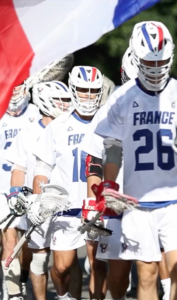 MerciSF: What happened after you joined the French team in 2016?
Dylan Snyder: My first tournament was in 2016. I wasn’t a French citizen yet, but the roster allows four players with a French connection, even without passports, so I qualified that way.
I played from 2016 to 2023, captaining the team at two World Championships and the 2022 European Championships. My brother later joined as a player, and my dad became team manager. After our best-ever finish in 2023, I was elected Vice President of Association France Lacrosse (AFL) and, in 2024, appointed head coach and director of all national teams.
MerciSF: That’s a major leadership role. And you’re still based in California?
Dylan Snyder: Yes, I’m still in the Bay Area and coaching at Marin Catholic—back to my roots! I also help with the San Francisco Riptide, a youth and community program run by Steve Dini, Advancement Director at The International School of San Francisco, who invited me to lead today’s clinic.
MerciSF: Can you explain what the AFL is and how it differs from a federation?
Dylan Snyder: Sure. The AFL—Association France Lacrosse—is the national governing body for the sport in France. But it’s still classified as an association, not a federation. The big goal right now is to gain federation status, like the Fédération Française de Football in soccer. That recognition is critical for things like funding, access to public sports facilities, and Olympic development programs.
MerciSF: How developed is lacrosse in France today?
Dylan Snyder: It’s still young, but growing fast. The AFL was founded in 2008 by two friends, Nicky Constant and Francois Labbé, after they watched American Pie—yes, really! For a while, it was a very casual, social sport.
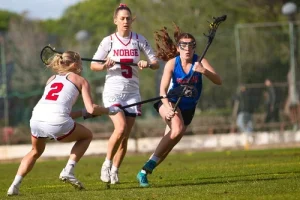
Photo credit: Sébastien ‘Babs’ Raynal
When I joined in 2016, France ranked 21st in Europe and 33rd in the world in 2018; today, we’re 8th and 17th respectively. Membership has jumped from 85 to over 320 in just 16 months, and we’ve doubled our teams from six to twelve. When I took over in 2024, there was only a men’s field team—now we oversee all 16 national programs across men’s, women’s, and youth divisions. The biggest growth has been in the women’s game: from just three players 18 months ago to over 40, with our first-ever women’s national tryouts held last weekend in France.
MerciSF: That’s impressive growth. What’s driving it?
Dylan Snyder: All the hard work done on the ground in France. Recruiting French-American players has also helped tremendously. But even more, it’s about building bridges between the American and French players. In the early years, there was tension—some French players felt sidelined when we brought in more experienced American teammates.
Now, we’re working together to build a sustainable French league that can develop homegrown talent over the next decade. The more competitive the domestic league becomes, the stronger the national team will be.
MerciSF: What are the biggest challenges you face in developing the sport?
Dylan Snyder: Two main ones: equipment and infrastructure.
Lacrosse gear is bulky and expensive to ship to France—there’s no local manufacturing yet. I personally send about $2,000 worth of equipment every six months. I’ve learned that a box of lacrosse balls just barely fits under the airline overweight limit, so I personally carried 90 pounds of balls through Charles de Gaulle Airport last weekend! Every player brings an extra bag of gear—it’s scrappy, but that’s what it takes right now.
And because most sports fields in France are publicly owned, priority always goes to federated sports—like soccer or rugby. As an association, we often lose field time to, say, a U9 soccer team. That’s another reason federation status is so important for us.
MerciSF: Are you getting any sponsorship or funding to support all this development?
Dylan Snyder: Not yet. We’re looking for corporate sponsors in France and in the U.S.
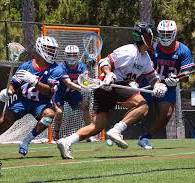 We’re completely self-funded. Every player pays their own way—for the last European Championship, it cost each player about $2,300 just to participate. That’s one of our biggest challenges.
Until we achieve federation status, we don’t receive any government funding. Once we become a recognized federation, we’d automatically qualify for around €500,000 annually from the French government. Compare that to our current annual operating budget of about $22,000—you can see how transformative that would be.
MerciSF: What role does the Olympic Committee play in your development?
Dylan Snyder: They’re tracking our membership numbers closely. Once we reach 1,000 registered members, we can qualify for federation status. We’re at about 320 now, so spreading the word—even through an article like this—helps us get there.
Anyone can join: you don’t even have to play. Paying the 60 € lifetime membership fee makes you an official member of the AFL, supporting both our funding and our recognition efforts.
MerciSF: Lacrosse is returning to the Olympics in 2028. What does that mean for the French team?
Dylan Snyder: It’s huge. Lacrosse hasn’t been in the Olympics since 1908. For 2028 in Los Angeles, a new, faster version of the game has been created to make it more accessible and gender-balanced. France is already preparing to compete, and if all goes well, we hope to be in Brisbane 2032 as well.
MerciSF: Do you see support from the French-American community?
Dylan Snyder: Absolutely! Especially in Paris. We didn’t even have a Paris team until early 2024. Then we launched one, and within a week, our WhatsApp group grew from zero to 350 members—mostly American expats who missed the game.
One of our players in Angers, Julien Wosnitza, owns three bars in the town square. He plays lacrosse games on all the TVs and offers a free drink to anyone who joins his team. That’s the kind of grassroots energy we’re building on.
MerciSF: For readers who want to help, what’s the most direct way to support France Lacrosse?
Dylan Snyder: The simplest way is to become a member of the AFL. Visit our website, sign up, and you’ll be counted among our official members. It helps us get closer to federation status—and ultimately to representing France at the 2028 Olympics.
We’re also always open to partnerships, sponsors, and volunteers who want to help grow the sport in France. Whether it’s equipment donations, field connections, or media support—it all makes a difference.
MerciSF: Finally, what’s your vision for the next few years?
Dylan Snyder: I’d love to see France Lacrosse reach federation status by 2026, double our player base again, and send competitive men’s and women’s teams to the 2028 Olympics in Los Angeles. But beyond medals, my goal is cultural: to make lacrosse part of the French athletic identity, a sport that bridges our American and French communities in the same way my own story does.
MerciSF: Merci Dylan, and best of luck for the future of France Lacrosse!
Dylan Snyder: Thank you! I appreciate the support.


