


After sixteen years in Seattle, Éric Thuau took the helm of International School of San Francisco, formerly French American International School, this summer. As the new school year begins with the opening of a new high school, the much-anticipated launch of a cafeteria and a major transformation of the campus, he steps into the role with extensive experience in international education and a clear conviction: the school must continue to evolve without losing what makes it strong — its community, its bilingual identity and its openness to the world. We sat down with him.
When asked to sum up how he feels as he takes the reins at International School of San Francisco, two words immediately come to Éric Thuau — in English: “happiness and gratitude.”
 Happiness, first, at joining a school he had followed for years and whose reputation he already knew well. Gratitude, too, toward those who have shaped the school since its founding in 1962.
“I’m truly very happy to be succeeding Melinda and all the heads of school who have helped shape this institution,” he says. He describes a community in which he already senses “a great deal of inspiration, creativity and entrepreneurship.”
A vocabulary that suits him well.
From Cape Verde to San Francisco: a decidedly international career
Éric Thuau’s career in education actually began far from the traditional classroom. As a teenager, he earned his BAFA youth-leader qualification at 17, after spending much of his own childhood at summer camps. At 21, he completed the BAFD certification, became a summer-camp director and later trained activity leaders and directors. Working alongside the many teachers involved in that world gradually clarified his own calling.
At the end of his training in 1998, military service was still compulsory in France. Rather than joining the military, he chose France’s overseas cooperation program and moved to Cape Verde, in Praia on the island of Santiago. His assignment: lead a French school and work toward its accreditation by the French Ministry of Education. Fresh out of university, he suddenly found himself running a school spanning preschool through 12th grade while also teaching first grade.
“I told my team: you have the practical experience, I have the theory, so we’re going to work together.”
The experience could have ended abruptly when a motorcycle accident required him to be medically evacuated to France for surgery. But he was determined to return and complete his mission. Together with his team, he ultimately secured accreditation for the school’s elementary program.
Next came four years in Bursa, Turkey, at a Mission laïque française school serving, among others, expatriate families connected to Renault and its suppliers. Once again, he wore several hats: director, but also teacher of mathematics, chemistry, biology and, at times, management, communications, music and physical education.
In 2004, it was time for another continent.
He joined what would become Austin International School in Texas. The school was only three years old at the time and still operated almost like a start-up. Over six years, he helped oversee its growth, accreditation and real-estate development. Then came Seattle in 2010. He expected to stay for a few years. He stayed for sixteen. “I fell in love with the region and the community,” he recalls. And he was not particularly looking for a new position when the San Francisco opportunity arose.
“I wasn’t applying anywhere. I was genuinely very happy at that school. But International is a school that has always inspired me because of its very cosmopolitan, open-minded community and its values.”
San Francisco, incidentally, was not entirely unfamiliar to him. He first discovered the city in 1994 during a trip to the United States. More than thirty years later, he is back — this time to stay.
A school “like the United Nations headquarters”
What particularly appeals to Éric Thuau about International is precisely this mix of cultures. In Seattle, he liked to compare the hallways of his school to the United Nations headquarters, with languages, nationalities and traditions intersecting every day. He finds that same energy in San Francisco.
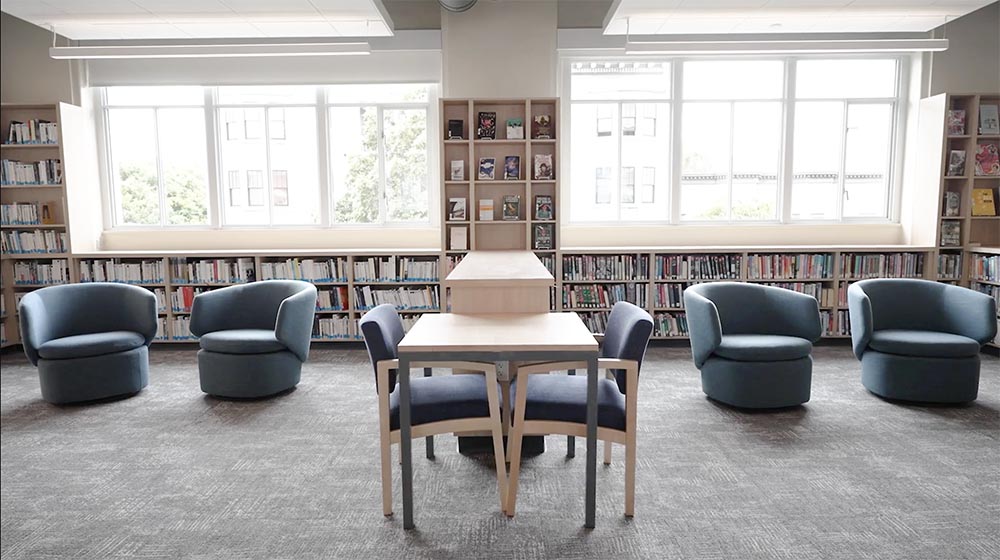
International Library
For him, this diversity is not simply a demographic characteristic of the school. It is an essential part of the education itself. Preparing students to thrive in international environments, understand other cultures and naturally reach out to others is central to the mission of a school like International.
He points in particular to the distinctive confidence he sees in alumni who grew up in highly international school environments: an ease in speaking with adults, navigating different cultures and finding their place in the world.
And he wants to take that further.
“Opening our school even more to the world”
It is probably the phrase that comes up most often during our conversation. Éric Thuau likes open schools. First, schools that are open to their neighborhoods. International’s urban campus interests him for precisely that reason. Existing collaborations with institutions such as SFJAZZ and the Conservatory help students understand, he says, that a school does not exist in isolation.
And then there is openness to the world.
He points to the Global Travel program, but also envisions expanding longer-term exchanges with schools abroad. In Seattle, some of his middle-school students spent five weeks at partner schools in Taipei, the Canary Islands or France.
“When they come back, they’re not the same.” He would also like to explore teacher exchanges, welcome educators from other countries and strengthen professional development around bilingual education.
“If I had to sum it up, it’s about opening our school even more to the world.”
A new high school and a transformative new school year
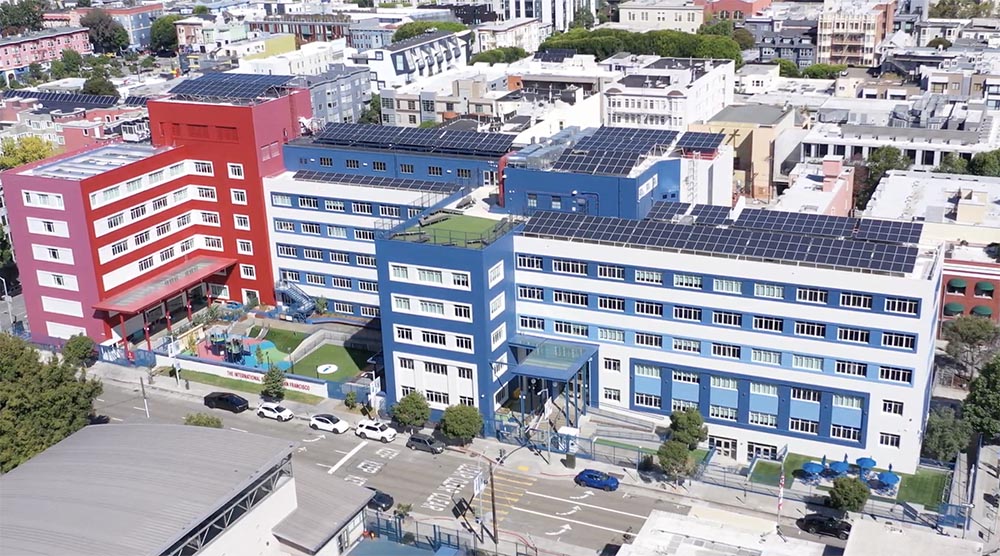
His arrival coincides with a dramatic transformation of the campus. The departure of Chinese American International School from part of the facilities now means that the High School has a space of its own, physically separated from the younger students. The new high school occupies approximately 60,000 square feet, according to figures discussed during our interview — to be confirmed by the school — and includes new classrooms, laboratories, a fitness room and numerous spaces where students can gather, work and collaborate.
A significant portion of the rest of the campus was also renovated over the summer, with new windows, redesigned spaces, new flooring and, now, air conditioning throughout the school.
Éric Thuau says he was impressed by the “efficiency, speed and quality” of the work completed since the beginning of the summer. But he is quick to put the importance of buildings into perspective. “Buildings aren’t everything. They are there to support the program and the way we work. What truly gives our school its value is its community, its teachers and our students.”
And finally… a real cafeteria
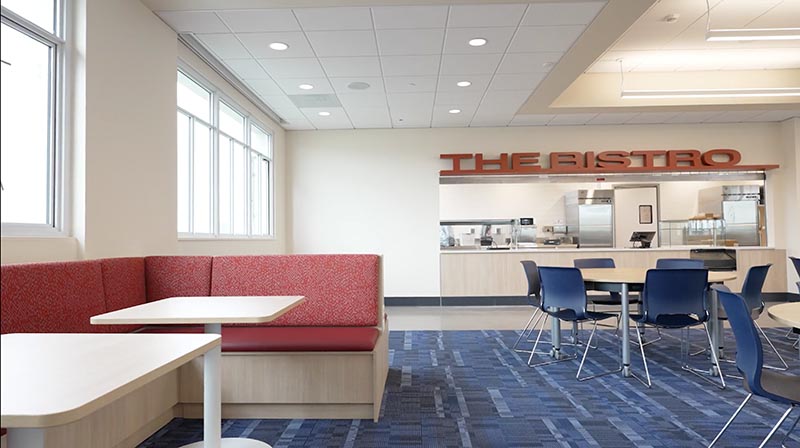 For many of the school’s French families, it is almost a cultural revolution: the daily lunchbox is now a thing of the past. The new cafeteria opens this school year for all students.
And when the word “cafeteria” comes up, Éric Thuau smiles. “I’d call it more of a restaurant.”
He describes menus prepared with fresh ingredients and options designed to accommodate different dietary needs. High school students will also have access to a bistro-style space offering an even broader selection.
Beyond the obvious convenience for families, he also sees it as an important part of school culture — and, yes, something distinctly French.
Sharing a meal, sitting down together, talking: “I think it’s better because you share a meal and exchange ideas. That’s true for the students, but also for colleagues.”
For anyone who has packed hundreds of lunchboxes over the years, it is hard to disagree.
French remains very much part of the equation
Since changing its name, French American International School has become International School of San Francisco. The word “French” has disappeared from the name. The school’s French component has not. And Éric Thuau is particularly clear on one issue that may concern some families: there are currently no plans to discontinue the BFI, the French International Baccalaureate.
He acknowledges that fewer students currently choose this track than the IB, but strongly defends its relevance.
“That doesn’t make it any less legitimate as a program. It is a truly high-quality program. I want to continue the BFI because it also gives our students options.”
Some students will go on to American universities, while others will head to Europe or France. For him, International’s strength lies precisely in offering that range of pathways.
The IB, meanwhile, is expected to continue expanding. The school already offers the Diploma Programme in high school and is currently working toward authorization for the Middle Years Programme (MYP) in middle school. The final visit is scheduled for December 2026, and Éric Thuau says he is very optimistic about the outcome. Longer term, the school could also consider the Primary Years Programme for younger students. French, American, international? For him, these identities are not at odds. On the contrary, French provides an additional dimension within a school that sees itself as multicultural.
In San Francisco, there is no avoiding the question of AI
Taking the helm of a school in San Francisco in 2026 also means having a front-row seat to a technological revolution that is already reshaping education. When it comes to artificial intelligence, Éric Thuau takes a clear position: banning it is not the answer.
“If you try to ban it, people will find a way around the ban. So there’s no point.”
His experience in Seattle likely helped shape that approach. In a city dominated by Microsoft and Amazon, his school regularly collaborated with engineers and parents working in tech. Technologies that were still experimental were tested with students, particularly in areas such as digital art and Minecraft. He would like to recreate that same proximity between education and innovation in San Francisco.
That means bringing into the school people who are developing these technologies today, exposing students to what is being built around them and teaching them how to use these new tools responsibly. Because while artificial intelligence can produce information in seconds, he believes it makes certain human skills even more important.
Critical thinking, discernment, the ability to evaluate a source and apply human judgment.
“Our goal is to support students so they don’t fall into the trap of no longer producing anything themselves.” And if AI allows teachers — or Thuau himself — to save time on certain tasks? All the better. “That’s more time I can spend with parents, colleagues or students.” Technology, then, as a means of returning to what lies at the heart of education: the relationship between teacher and learner.
Arriving without a “toolbox”
Despite his experience and nearly three decades in international education, Éric Thuau is determined not to give the impression that he has arrived in San Francisco with a fully written agenda. “There are so many things already happening at this school that I’m not coming in with my toolbox saying, ‘Here’s what needs to be done.’” His first months will be about observation.
Meeting teachers, staff, students and families. Understanding what already works very well, identifying what could be improved, and then thinking with the Board about the next step. He also speaks of a desire to better support the diversity of learning profiles, including students who need greater academic stimulation. Again, no overnight revolution is being announced. Rather, a method: listen, understand, experiment, adjust.
We asked Éric Thuau where he hopes International School of San Francisco will be in five years. His answer was less about predicting the future than about staying in motion — adapting, learning and evolving without losing the school’s strong bilingual and international identity.
His first San Francisco favorites
Éric Thuau did not wait long to start enjoying his new city. During his first week in San Francisco, two of his very first decisions were to become a member of SFMOMA and SFJAZZ.
“I really love music, art and the arts in general.”
As for French food, the campus’s location has already made it easy to explore a few nearby favorites, including Absinthe and Chez Maman, while L’Ardoise has also made his list of go-to addresses.
As for everything else, there is plenty of time. After sixteen years in Seattle, a new life is beginning in San Francisco — and a new chapter is opening for International School of San Francisco as well.


