Alice Diop, one of the leading voices in contemporary French cinema, whom Le Monde called “the new face of French cinema” in 2022, will be at UC Berkeley starting September 3 for a series of film screenings and events organized in part with the Department of French.
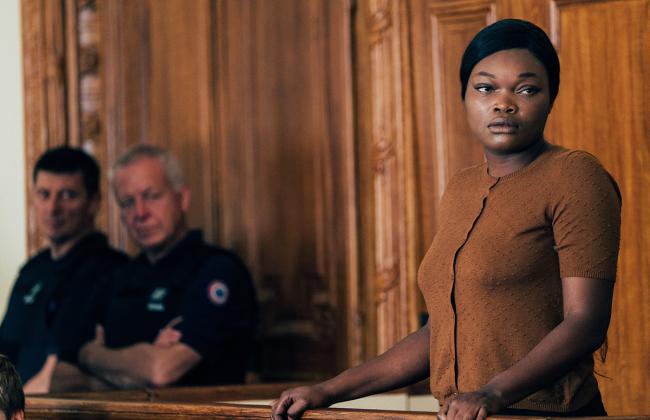 Six films by the Seine-Saint-Denis-born filmmaker will be screened at BAMPFA, the Berkeley Art Museum and Pacific Film Archive. Diop will take part in conversations and Q&As with Berkeley professors following four of the screenings, all open to the Bay Area public: Saint Omer (September 3), Nous (September 4), La Permanence (September 10), and La Mort de Danton/Vers la tendresse (September 13).
Two additional films, Fragments for Venus and Les Sénégalaises et la Sénégauloise, will also be screened free of charge, although Diop will not be present.
The filmmaker will hold the prestigious Avenali Chair in the Humanities at UC Berkeley and will also serve as “The Pajus Distinguished Visitor” in the Department of French. At an event reserved for the UC Berkeley community, she will also present a poetry reading, Le Voyage de la Vénus Noire, a solo performance she presented last year during a European tour.
On September 8, Berkeley’s Center for Interdisciplinary Critical Inquiry will host a public roundtable titled “Encounters with the Question of Race in the Cinema of Alice Diop.” The filmmaker will join professors Farah Bakaari, Nadia Ellis, and Mario Telò for a conversation about representations of race, the Black diaspora, gender, archives, and colonial legacies in her films. The event will take place from 5 to 7 p.m. in the Maude Fife Room (315 Wheeler Hall).
Finally, Alice Diop will discuss her upcoming feature film, a fictional work based on Michel Leiris’s L’Afrique Fantôme, a text about the Dakar-Djibouti anthropological expedition of 1931–1933. The book notably documents and exposes the acquisition, requisition, and often forced removal of African sacred objects and works of art — an issue that remains particularly relevant today.
L’Afrique Fantôme is known for its hybrid form, combining Leiris’s observations during the anthropological expedition with a personal diary that examines his own complicity in the colonial system. Alice Diop approaches L’Afrique Fantôme from an entirely new perspective: that of Malkam Ayyahou, the woman at the center of Leiris’s romantic obsession. In doing so, Diop reverses Leiris’s objectifying gaze while giving Ayyahou a presence and a voice of her own.
Diop’s cinema is known for precisely this kind of shift in perspective. Her films do not simply criticize the omissions or injustices of mainstream cinema; instead, they place stories, places, and communities long considered “marginal” — particularly those of the Paris suburbs — at the center of the Francophone cinematic imagination.
Her films challenge the collective narratives that have long defined places such as Seine-Saint-Denis, offering instead intimate stories grounded closely in the realities and lives unfolding there. Across eight documentaries and her first fiction feature, Saint Omer (2022), she has developed a body of work marked by formal rigor and a deep ethical commitment, attentive to the intersecting pressures of racial, economic, geographic, and gender-based exclusion.
Alice Diop looks forward to meeting the Bay Area’s Francophone community, in a region she has long wanted to visit.
Maya Sidhu
Maya Sidhu has been teaching in UC Berkeley’s Department of French as a lecturer since the fall of 2016. She holds a PhD in French and Francophone Studies from Northwestern University. Her work has been published in Camera Obscura, French Screen Studies, Éditions de la Sorbonne, and The Women Film Pioneers Project. She is currently writing a book on Alice Diop.

French Electro-Pop Sensation Polo & Pan Set to Light Up Stanford in October

San Francisco's Blue House and the French community...

Support Theater in French at TLF, and Discover 2023 Line Up!

Top Outdoor Swimming Pools in the San Francisco Bay Area in 2025

Organized by French Tech SF & the Consulate - Ensuring the Security of the IoT