


Based in San Francisco for over two decades, Nolwenn Godard has built a unique career at the crossroads of technology, public policy, and impact. A former executive at PayPal and SoFi, she was appointed by California Governor Gavin Newsom to lead the Office of Data and Innovation, where she contributed to the state’s first executive order on generative artificial intelligence.
Today, as the founder of Carbon 2C, co-author of Sustainable by Design, and an active member of the Green Software Foundation, she is focused on making technology more sustainable. Her ambition is clear: align the pace of technological innovation with the urgency of climate action.
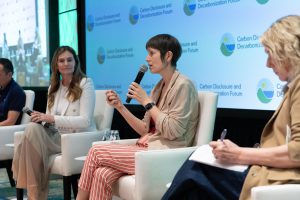
MerciSF met Nolwenn during SF Climate Week, following the panel she led at the World Economic Forum titled “The Hidden Cost of Intelligence: Building AI That Doesn’t Drain the Planet.” A topic that reflects her own positioning—at the intersection of climate and cutting-edge technology.
A Purpose-Driven Path into Tech
Born to a Breton mother and a Norman father, Nolwenn Godard grew up in Chartres before attending ESSEC Business School in Paris. Early in her career, she chose an unconventional route, spending nearly two years in Lebanon working in the nonprofit and international development sectors.
“I’ve always had a strong sense of social purpose,” she says—a mindset shaped early on by her father, an environmental economist at the CNRS (France’s leading research institution), who introduced her to climate issues from a young age.
Back in France, she joined Ubisoft, starting in finance before transitioning into IT, where she led ERP implementation projects across Europe. A professional opportunity eventually brought her to San Francisco—a city she quickly embraced as home.
Discovering “Tech for Good” at PayPal
To remain in the U.S., Nolwenn joined PayPal, where she secured her green card and built an international career, particularly across emerging markets.
It was there that she discovered what would become a defining thread in her career: “Tech for Good.”
“We were enabling small businesses to access online payments—something that had previously been out of reach,” she explains. Through her work in Latin America and the Middle East, often in collaboration with governments, she contributed to expanding financial inclusion.
The takeaway was clear: technology can be a powerful driver of economic and social impact.
From the Private Sector to Public Impact
 But for Nolwenn Godard, scaling impact meant going further.
While the private sector can deploy solutions at scale, she realized that public policy has the power to reach entire populations. A single government decision can impact millions.
After being spotted at an event at University of California, Berkeley, she joined the California state government and was appointed to lead the Office of Data and Innovation by Governor Gavin Newsom.
Inside Government: Data, Climate, and AI
Leading a team of around 60 experts—data scientists, engineers, product managers, and designers—she worked on projects bridging technology and public policy.
Among the most impactful initiatives: developing models to anticipate water shortages in California, helping communities better prepare for drought conditions.
She was also at the forefront of the rise of generative AI, contributing to the development of responsible usage frameworks within government.
A Turning Point: Climate and AI as One Challenge
Her defining realization came from both professional experience and lived reality.
Wildfires, orange skies over San Francisco, floods—“That’s when it hit me: climate change isn’t a problem for 100 years from now. It’s happening now.”
From that moment on, she saw climate and artificial intelligence as deeply interconnected challenges that must be addressed together.
Carbon 2C: Building More Efficient and Sustainable Tech
With Carbon 2C, Nolwenn Godard is turning that conviction into action.
Her observation: awareness of climate issues within the U.S. tech ecosystem is still lagging.
Her approach operates on two fronts: education and training for companies and future engineers, and operational support, advising CTOs on how to align performance with environmental impact
This includes optimizing systems through better AI model selection, improved workload management, and right-sizing the infrastructure.
“Today, many companies over-provision their resources, leading to unnecessary energy consumption,” she notes.Her core belief is pragmatic: reducing carbon footprint also reduces costs.
AI and Climate: An Unresolved Equation
 For Nolwenn Godard, artificial intelligence is both part of the solution—and part of the problem.
On one hand, it enables major advances in climate modeling, scientific research, and energy optimization. On the other, its environmental footprint is already significant, driven by the massive energy, water, and resources required to power data centers.
“We’re still facing a very uncertain cost-benefit equation,” she says.
Acting Rather Than Debating
In response, she calls for collective action: stronger regulation, increased public pressure, and greater awareness among companies.
For her, the issue goes beyond environmental responsibility—it’s also about the long-term viability of economic models.
Optimism or pessimism? She dismisses the question. “Both can lead to inaction.”
Her philosophy is simple: act. “What matters is doing what needs to be done.”
A Strong Commitment to the Community
Deeply involved in the French-American community, Nolwenn Godard has long contributed to strengthening ties between France and the Bay Area, notably as a board member of the EFBA.
Now a U.S. citizen, she remains closely connected to her French roots and values—liberty, equality, fraternity—which she continues to promote. She is also running in upcoming consular elections, aiming to serve the community through public engagement.
In San Francisco, she embraces a lifestyle shaped by both cultures: daily swims in the bay, walks along Land’s End that remind her of Brittany, weekend visits to farmers markets, and a strong appetite for culture and ideas.
A Career Driven by Impact
From Silicon Valley to public institutions, Nolwenn Godard has consistently followed one guiding principle: using technology as a force for the common good.
Her ambition is clear: help make both the climate and technological transitions more responsible, more human—and ultimately more sustainable.


