


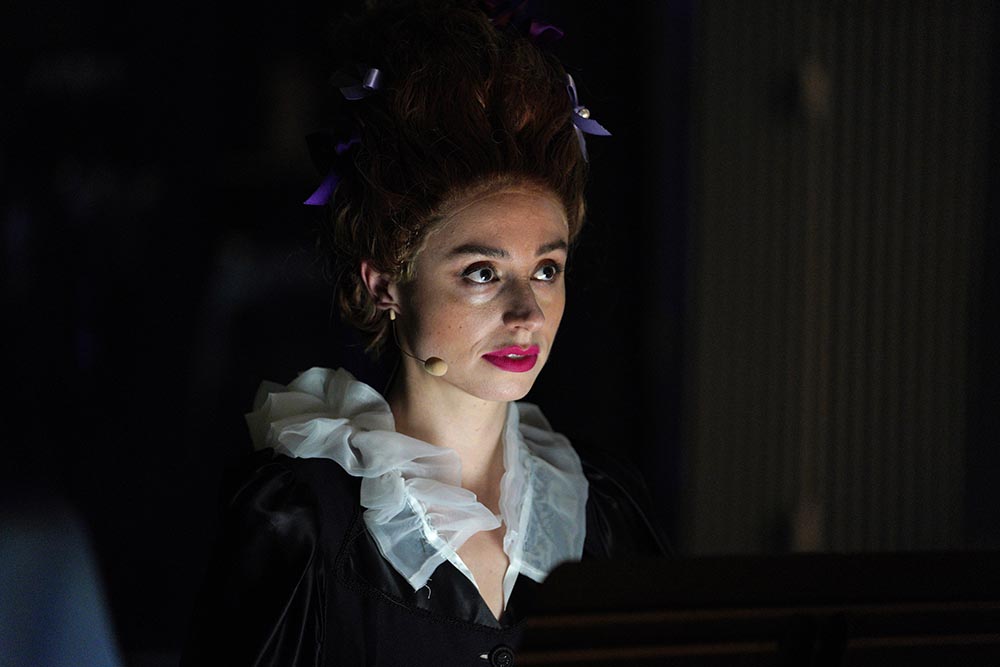
The Franco-American mezzo-soprano opera singer Sophie Delphis will take the stage in La Belle et la Bête, Philip Glass’s opera, in Opera Parallèle’s distinctive production, presented for two performances in Berkeley. She performs the double role of Félicie / Adélaïde, Belle’s two sisters—a part that is as delightful as it is symbolic.
On the occasion of these performances, she reflects for MerciSF on her journey, her relationship to singing, to the French language, to the body, and on 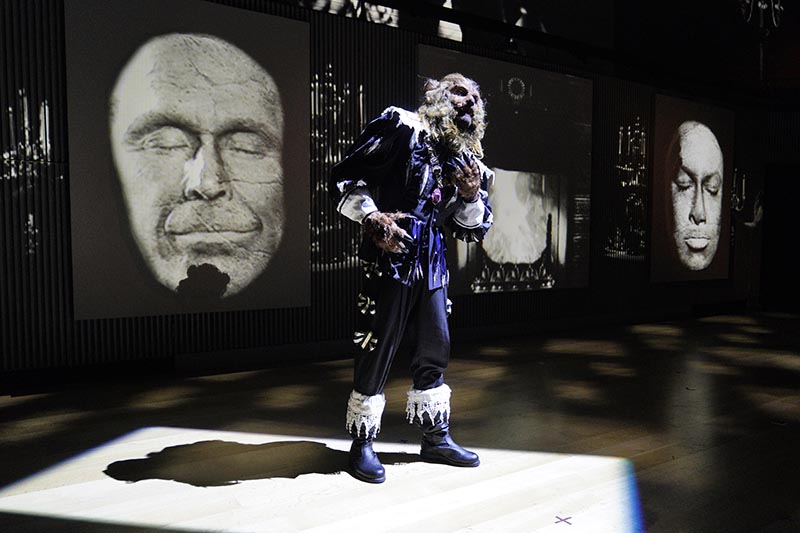 what this “magical” work represents for her today.
A path not necessarily destined for opera
Unlike many opera singers, Sophie Delphis did not originally set out for a musical career. She began singing almost by chance as a child, “to learn how to place the voice properly,” at the initiative of her mother, Marylène Delbourg-Delphis. The piano did not appeal to her—too much execution, not enough thought—but singing gradually took hold, without immediate certainty.
At 14, she was suddenly cast in her first opera, Amahl and the Night Visitors by Menotti. Rehearsals were a trial, but the stage proved revelatory. “I hated rehearsals, but I fell in love with performing.” The adrenaline, the relationship with the audience, the theater—something took root.
She went on to study at the New England Conservatory in Boston, then at the University of Michigan, while maintaining for a long time a certain inner distance from her own profession. “For years, I sang without really feeling like a singer.”
Finding her voice… and her path
The real turning point came during the pandemic. Deprived of stages, contracts, and structure, Sophie Delphis was confronted with an essential question: why sing, when there is nothing left to prove?
“That’s when I understood that I sing because I love to sing. Not just to be on stage.”
This realization profoundly transformed her relationship to music. Singing became a bodily, almost muscular pleasure, no longer solely a performative act. The voice ceased to be a tool and became a place.
A rebirth after illness
To this intimate redefinition was added a major ordeal: cancer, which kept her away from the stage for nearly a year. Chemotherapy, radiotherapy, CAR-T cell therapy… and then, despite everything, a return.
Her audition for a project at the Brooklyn Academy of Music (BAM) took place without hair, without recent engagements, but with disarming honesty. “I’m very happy to sing for you, especially since I haven’t sung for months, because I have cancer.”
That project, What to Wear, presented as part of the Prototype Festival, marked a true artistic rebirth. “I didn’t know if I would be able to sing again. Today, I sing a lot. It’s a rebirth.”
Félicie / Adélaïde: the necessary ‘villains’
 In La Belle et la Bête, Sophie Delphis embodies Belle’s two sisters, Félicie and Adélaïde—characters often seen as secondary, yet essential to the architecture of the tale.
“They are part of the fairy-tale mechanism of the story. They serve as a counterpoint.”
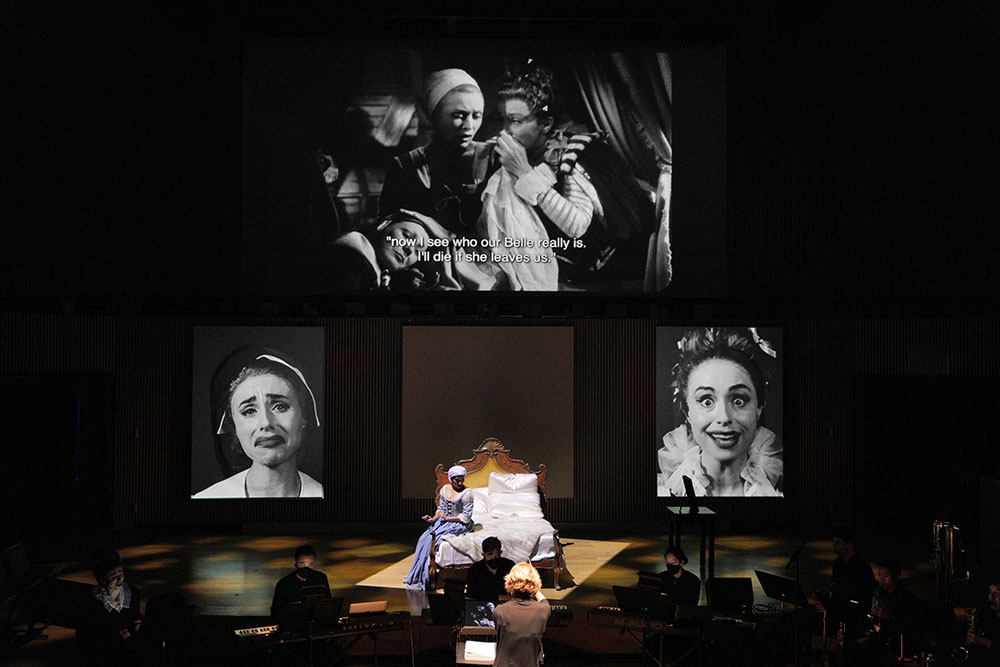
This double role allows her to play with vocal colors, between soprano and mezzo, and to enjoy the contrasts in character. In this unique version, where Cocteau’s film is projected while the singers perform the score live, the performance becomes an exercise in extreme precision.
“It’s live playback. You have to sing exactly when you see the lips move on screen.”
Opera Parallèle pushes the multimedia experience even further by integrating filmed images of the singers themselves, layered over the original film.
“I love this collage aspect. It’s total multimedia.”
Philip Glass: making the film feel natural
While Cocteau’s film may sometimes feel excessive to contemporary audiences, Sophie Delphis explains that Glass’s music gives it renewed coherence: “With Philip Glass’s score, everything becomes natural. Melodrama becomes self-evident.” His pared-down, almost spoken musical writing calls for a different approach to traditional operatic singing. “I sing Glass as if I were speaking.” An aesthetic that perfectly matches her love of language, poetry, and textual precision.
The body, language, thought
Alongside her singing career, Sophie Delphis is pursuing a PhD at CUNY (New York), focused on the performer’s body, the French language, and the musical setting of poetry—particularly Mallarmé in Ravel.
“My passion is the performer as co-creator.” This reflection is deeply informed by her experience of illness, which she never perceived as a rupture but as a continuation. “I experienced cancer as a performance. You had to prepare, to recreate yourself.”
A work, an experience
For Sophie Delphis, La Belle et la Bête goes far beyond the framework of a simple opera. “It’s a unique experience. Magical for the audience, magical for the performers.”
One word comes up again and again: magical. And it perfectly captures this work at the crossroads of cinema, music, body, and voice.
La Belle et la Bête by Opera Parallèle
Dates: March 13 & 14, 2026
Address: 101 Zellerbach Hall, Berkeley, CA 94720
Tickets: click here
Follow Sophie Delphis
instagram: @ sdelphis
youtube books : @ bibliosophie
substack: https://sophiedelphis.substack.com


