World-renowned French explorer and pioneer of polar expeditions, Jean-Louis Étienne is in San Francisco this week for a landmark stopover aboard his scientific sailing vessel Persévérance. Invited by the Consulate of France and the Sustainability Committee of the French-American Chamber of Commerce, he shared with MerciSF his extraordinary journey: from childhood dreams in the Tarn to legendary polar expeditions, and his latest scientific project, the Polar Pod. On the eve of his 80th birthday, Jean-Louis Étienne impresses with his unflagging energy and deep conviction that exploration remains an essential tool for understanding tomorrow’s climate challenges.
MerciSF: Where does your passion for adventure and scientific exploration come from?
Jean-Louis Étienne: I was born in the Tarn, in a farming village, far from the sea and the mountains. But as a child, I loved being outdoors and was already imagining expeditions. At 14, I was making gear lists for winter camping trips in the Pyrenees. My studies didn’t seem like those of a future explorer: I began with a vocational certificate as a turner-miller. But a math teacher, Madame Pujol, encouraged me to go further. I eventually studied medicine and became a surgical intern. Still, my dreams of expeditions resurfaced, and I decided to put my medical skills at the service of adventure.
What did your first expedition look like?
I crossed the Atlantic as a doctor aboard the Bel Espoir, a sailing vessel run by Father Jaouen that helped former prisoners and drug addicts reintegrate into society. Then I joined Éric Tabarly for a round-the-world race. I wasn’t a racer, but I brought medical expertise. On a boat, you learn quickly: navigation, sextant, weather. For more than ten years, I took part in expeditions as a doctor, sailor, and mountaineer.
When did you decide to become a full-time explorer?
In 1984, during an expedition to Everest, I asked myself: “Where is my Cape Horn, my own Everest?” That’s when the North Pole became clear to me. It brought together all my experiences: the icy atmosphere of high mountains, the maritime challenge since the North Pole lies in the middle of the Arctic Ocean, and the extreme physical trial. After failing in 1985, I succeeded the following year, reaching it solo after 63 days on the pack ice, in temperatures as low as –52 °C.
With no GPS or phone, it was complete isolation from the world, where I learned the true meaning of perseverance. That victory shaped my life, and I chose to devote myself to polar expeditions.
What other major expeditions followed?
In 1989–90, I took part in the Transantarctica expedition, crossing Antarctica with an international team: an American, Russian, Chinese, Japanese, Englishman, and me, the Frenchman. Seven months with sled dogs, but above all, it had political impact: our expedition helped secure Antarctica’s protection from mining, preserving it as a land of science and peace. Later, I had a polar vessel built, Antarctica, designed to withstand crushing pack ice, inspired by Nansen. This ship, later renamed Tara, went on to lead major scientific missions.
I love inventing and building as much as traveling: every expedition is an entrepreneurial adventure, requiring as much funding and engineering as endurance in the field.
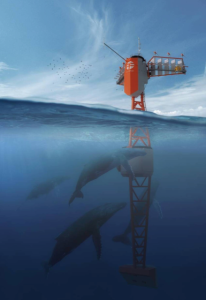 Can you tell us about your latest project, the Polar Pod, and what it aims to accomplish?
It’s a vertical scientific station designed to drift around Antarctica and withstand the storms of the roaring fifties. The Southern Ocean is the least known on the planet – often called the major data gap – and yet it’s vital: it alone absorbs half the CO₂ captured by the world’s oceans. The Polar Pod will continuously measure air-ocean exchanges, CO₂ flows, biodiversity, and the impacts of climate change. At 100 meters tall, higher than the Statue of Liberty, it will be zero-emission and energy self-sufficient thanks to wind turbines. Eight people will live on board, rotated every two months by the Persévérance. The mission will last three years, completing two full circuits of Antarctica.
You are in San Francisco with the Persévérance. What is its mission today?
It serves as both a scientific and educational platform. We work with researchers but also focus on raising awareness among young people and the general public. The aim is to share knowledge about the oceans and climate, and to show what’s really happening in the field.
Education has always been a strong component of your expeditions. What drives that commitment?
Because being in the field gives credibility. When I talk about melting ice or calving icebergs, I’ve seen them with my own eyes. The role of today’s explorer is to translate complex scientific phenomena into simple language, accessible to all.
It’s also a way to reconnect young people with nature, which works as a model of circular economy while our society drifts further away from it, and to inspire the next generation of climate advocates.
Can you tell us about your special connection with California?
Yes, I lived here for a few months in the 1970s, in San Francisco. What struck me then – and still does today – is the sense of freedom and creativity. Today, California is a tremendous laboratory of innovation, from artificial intelligence and energy transition to maritime technologies. But what moves me most is its strong environmental awareness, a desire to act for the ocean and the climate. American scientists, especially at the Scripps Institution of Oceanography in San Diego, are very open: their first instinct is to ask, “what can we do together?” It’s a spirit I would like to nurture by building lasting partnerships with California, with both scientific institutions and academia.
In your view, what are the major challenges facing the planet?
Climate remains the number one challenge. We are a carbon-based civilization, dependent on oil, gas, and coal. The consequences are already visible: warming oceans, floods, disruption of the water cycle… Yet we have the solutions to reach carbon neutrality by 2050, by shifting to flow energies – renewables and nuclear.
The ocean already plays a huge role, absorbing about 30% of CO₂, but we must accelerate the transition.
What message would you like to share with younger generations?
Desire. If you truly want something, that desire is your engine, your capital. But you must add work, time, and perseverance. The name of my vessel is no coincidence: perseverance is my inner drive. I know life has high tides and low tides, but difficulty is not a reason to give up. Resisting the temptation to quit is what allows us to progress and grow.
And in the face of climate change, giving up is not an option – on the contrary: everyone can act at their own scale – individual, family, collective. It’s the sum of small actions that creates real change.
Thank you, Jean-Louis Étienne

Frameline44 Festival presents House of Cardin

How to Celebrate Earth Day in April

La Bauloise: Authentic French Crêpes in San Francisco

The 68th San Francisco International Film Festival: our Selection of French Films

836M Gallery presents a photo exhibition in person!!