


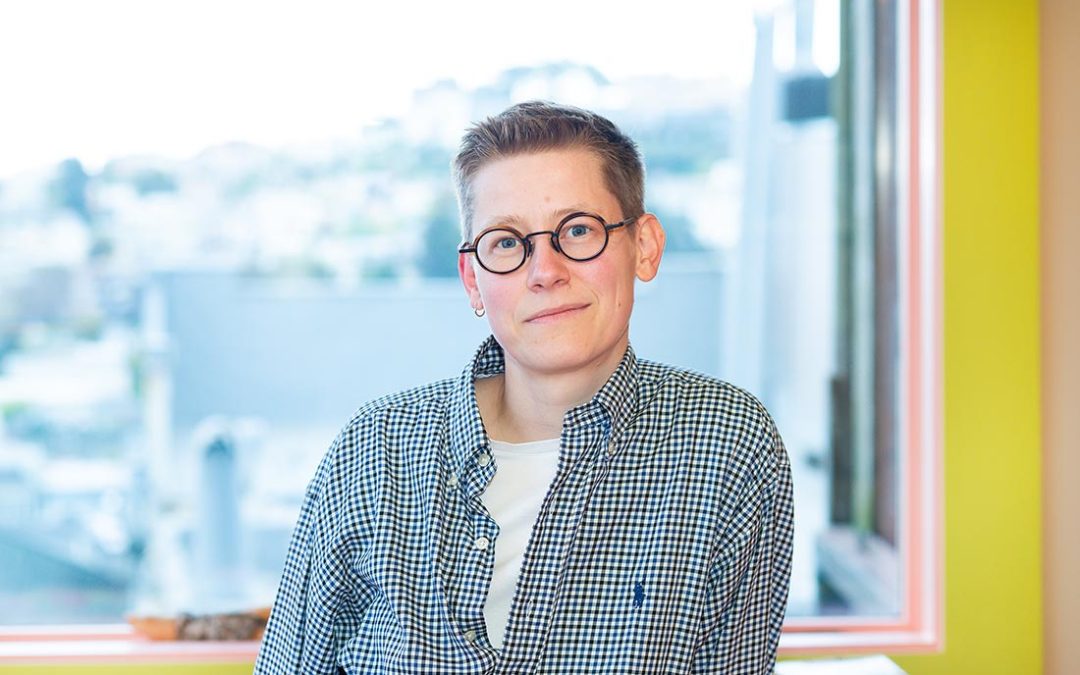
In June 2025, San Francisco celebrates Pride Month with vibrancy. In this context, art historian and curator Marine Kisiel is in residence at Villa Albertine, working on a project as original as it is necessary: reviving the forgotten queer trajectories of the 19th century through the history of fashion.
“I am an art historian, a museum curator, and head of the 19th-century fashion department at Palais Galliera in Paris,” she explains. After beginning her career at the Musée d’Orsay, Marine Kisiel decided to move away from the “bigger names” of art history to explore another facet of the 19th century: that of bodies, garments, and less visible lives. “I was a bit tired of managing power dynamics, in a way. I wanted to approach cultural and social history from the level of the body. Fashion allows me to do that.”
It was while co-directing the magazine Perspective with Matthieu Leglise and coordinating an issue on fashion history with Emilie Hammen that she entered a field still burgeoning in academia. She discovered in it a powerful tool for questioning not only taste and aesthetics but also social norms, gender, and identity. Her research thus took a resolutely queer direction. “I had the joy of seeing a new terrain open up, aligned with my personal concerns: who are our queer ancestors? Who were the gays, lesbians, and trans people of the past? Those who are not spoken about yet did exist”
Her exhibition project, provisionally titled Dandykes in English, will open in September 2026 at Palais Galliera. It will trace how, in the 19th century, women gradually appropriated the codes of menswear.
“I work on two levels: on the one hand, the masculinization of women’s fashion, a trend visible throughout society; on the other, I seek to determine whether we can outline a proto-lesbian fashion in the 19th century. An anachronistic notion since the word ‘lesbian’ was not used at the time, but the practices were there: women living together, dressing as men, taking to the sea or bearing arms under male identities and in men’s clothing.”
Among the key figures she highlights are George Sand, Jeanne Dieulafoy, and the painter Rosa Bonheur, famous for having been granted a cross-dressing permit so she could paint in trousers. “She created her own uniform, with vest, jacket, and skirt—an expression of style entirely her own. She wore it in all colors, almost like a signature.”
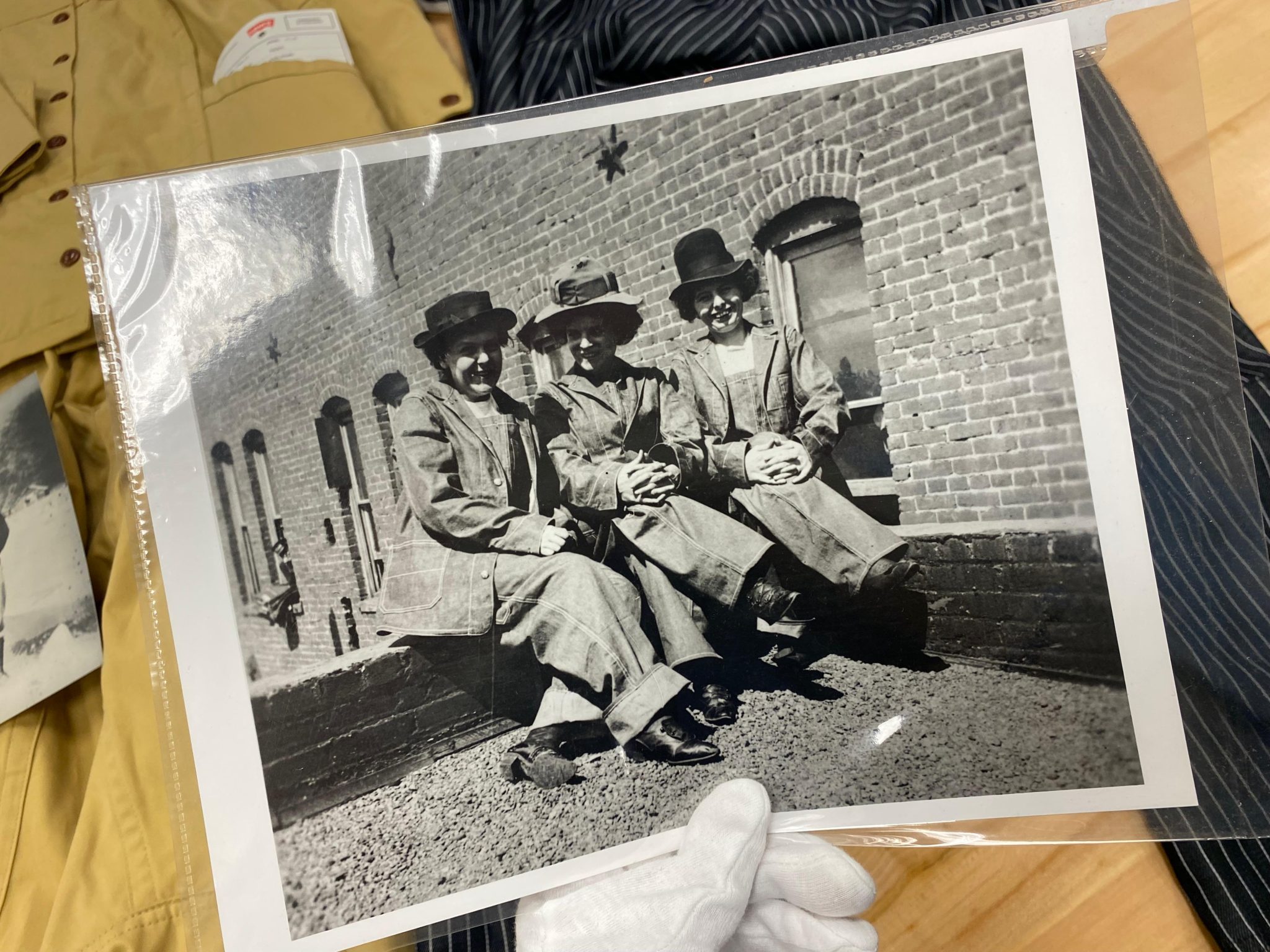
Levi’s factory workers in San Francisco. / Ouvrières des usines Levi’s à San Francisco © Levi Strauss & Co. Archives
San Francisco, the site of her residency (alongside New York), proves to be a particularly fertile ground for this research. First, because the city is one of the historical epicenters of LGBTQIA+ struggles. “It’s a mythical city, a cauldron of queer culture. There is an incredible collective energy here, driven by activists, libraries, and archives. All of this deeply feeds my thinking.” And also because it is a site of major material archives: such as the Levi’s collections, with which Marine Kisiel collaborates to trace the emergence of garments created for women in the field of workwear, initially exclusively masculine.
Though it is a paradox in this global hub of technological innovation, artificial intelligence plays no role in her process. “I rely above all on human intelligence and materiality. I want to show 19th-century pieces, not reproductions. Saying ‘we existed’ requires tangible proof: a photograph, a garment, an object. There is an economy of proof in that, which I believe in, and a very strong thread that connects us to the past.”
This relationship to archives is also a political stance. At a time when LGBTQ+ individuals are regularly targeted, Marine Kisiel sees the museum as a space for action. “Showing that these figures already existed helps defuse fear. It tells the public: they were there, you just hadn’t seen them. Yet everything was fine.”
Her work draws on both famous figures and anonymous lives, found in family albums, vernacular photos, or community archives like the Lesbian Herstory Archives in Brooklyn. “These are the people who slip through the cracks that I seek to bring back to light. Because in reality, it is us. And seeing ourselves, and allowing ourselves to be seen, is important.”
When asked what being a lesbian and “queer” means to her, Marine Kisiel responds with inspiration from a quote by the Radicalesbians, as powerful as it is poetic:
“A lesbian is the rage of all women condensed to the point of explosion.” Then she adds, “Being queer is living in dissidence. Seeing the world differently, more fluidly, less normatively, more explosively.”
Thanks to the time offered by Villa Albertine, she can bring this invisible memory to the surface. “Queer community life is made up of erasures. Having this time, this space, to bring fragments of history to the surface is precious. Working on this, with others, is perhaps a way to give everyone—especially the younger generations—something so they don’t have to reinvent the wheel every time.”


