


We had the pleasure of meeting Dr. Elsa Jungman, a pioneer in the field of skin pharmacology and founder of HelloBiome, a B2B platform dedicated to collecting microbiome data for clinical research.
With a PhD in dermatology, Elsa began her career in research and development at L’Oréal in Paris before dedicating herself to a mission close to her heart: promoting a healthy skin microbiome. Winner of two FABA awards last May and newly appointed ambassador of La French Tech, Elsa works to integrate microbiome science into cosmetic product development, putting her expertise to work for skin health.
In this interview, Elsa shares her extraordinary journey as a “solo founder,” including the challenges she successfully overcame and her commitment to skin health and the innovations she brings with HelloBiome.
You were one of the first to recognize the role of the skin microbiome in consumer health. What initially sparked your interest in the microbiome, and how did it evolve to become the foundation of your career?
When I was a teenager, I experienced toxic shock, which caused numerous skin problems and pushed me to take care of my skin. This sparked my interest in dermatology, which grew over time. Despite a difficult academic journey, with health problems hampering my studies, I decided to pursue biology studies and specialize in dermatology, determined to prove my worth and take revenge on my past academic struggles.
My career began in scientific research, where I specialized in the skin’s barrier function, analyzing how ingredients and products interact with the skin.
For years, the crucial role of the skin microbiome, which contributes to skin health, was largely overlooked.
 After seeing the inefficacy of many beauty products, often containing ingredients that were too harsh for the skin and disrupting the skin microbiome’s balance, and facing my own sensitive skin issues, I had an epiphany. I met a pioneering startup in the microbiome field, which opened my eyes to the importance of skin microorganisms. After conducting my own research, I realized there was a strong correlation between microbiome imbalances and the rise in skin problems, which motivated me to change the course of my career.
This realization led me to start my own company and create products that respect the microbiome, based on thorough research and data, to better protect and restore the skin’s barrier function. I’m not trained as a microbiologist, but I understood early on that microbiome knowledge was essential in developing formulas that preserve skin health.
How did you decide to transition from a B2C business model, with the Elsi and Dr. Elsa Jungman skincare lines and a microbiome test kit sold directly to consumers, to a B2B platform with HelloBiome?
Initially, I wanted to revolutionize the cosmetics market with independent brands, thinking that only new brands and movements like “clean beauty” could bring about the necessary change in the industry, as opposed to big established brands.
 But it turns out that large companies gradually realized that the microbiome is the future. Over time, my message about the importance of the microbiome resonated with these big groups, who now recognize that the microbiome is key to the future of their innovations. Even though they already have their own internal initiatives, they now seek our expertise to accelerate their progress by integrating technology and biology, areas where our company has a competitive advantage.
We also faced a series of financial challenges in B2C, and this pivot allowed us to find a more sustainable and scalable business model.
Today, we collaborate with several large groups like Unilever, providing tools to help them innovate and create products that better meet consumer needs, while continuing our goal to innovate in the field of skin microbiome.
With the launch of HelloBiome, what do you see as the most exciting recent advances in skin microbiome research, and how do you think they will shape the future of skincare?
Recent advances in skin microbiome research mainly focus on large-scale data collection, which is now faster and cheaper thanks to technological progress. Whereas sequencing used to be slow and expensive, it is now possible to obtain precise results in a week at a reduced cost. This improves our understanding of microbial profiles, promoting the development of predictive models and new skincare solutions.
Artificial intelligence and machine learning models play a key role in analyzing skin microbiome data, allowing for a better understanding of individual variations and their impact on skin types. With decentralized research through at-home testing, data collection has become faster and more diverse. By grouping this data, we segment individuals according to their specific microbial profiles, rather than classifying them according to traditional skin type categories.
This innovative approach allows for the development of more personalized products and new ingredients tailored to these subgroups.
What’s next for HelloBiome, and where do you see the company in the next 5 to 10 years?
We are currently raising funds to open our lab in France and grow our company, which is on the verge of breaking even.
Although we have found a real opportunity in the market, we need investments to improve our technology and grow our revenue, as our team is operating in bootstrap mode, with no dedicated marketing staff.
One of our flagship projects is PredictaBiome, which will allow us to create predictive models based on our proprietary data to develop new concrete innovations in cosmetics and consumer health, a crucial aspect that few companies in our sector address. Although PredictaBiome has not yet been officially launched, we already have interested clients, which is promising. This platform will enable us to create ultra-personalized products and ingredients, ensuring maximum effectiveness for each skin type.
Can you tell us more about this laboratory and why you chose to establish it in France?
We plan to open this first laboratory in France by the first quarter of 2025. Specializing in the development of innovative ingredients for skincare, this lab will be the first to transfer clinical results into microbiome predictive models, allowing for more targeted ingredient testing.
Rather than following the traditional method of testing extracts on skin profiles, we will reproduce different microbiome profiles (e.g., various types of dry skin) in the lab to determine which ingredient is most effective for each profile. This approach is at the core of the PredictaBiome platform, scheduled for next year.
France was chosen for this project due to its expertise in “tissue engineering” and skin models, unique skills in Europe. Additionally, financial support, tax incentives like the research tax credit, and regional aid make France an attractive environment for R&D, whereas in the United States opening a lab is more expensive and receives less support.
You founded your company during the pandemic while raising two young children. How did you manage to overcome both personal and professional challenges during that time?
Several mentors have guided me throughout my journey. The closest is Odile Roujol, who has been advising me for a long time, even before I became an entrepreneur, and she continues to do so today.
Many of my investors also act as mentors, especially during difficult times, where their support and advice are invaluable.
I also had a coach, Barbara Meyer, who helped me a lot, especially during my first fundraising and during my pregnancy. She gave me the confidence and perspectives to handle the challenges I faced at work, which was essential for me. Without her, I would never have found the courage to launch a microbiome test; the challenge scared me too much.
What advice would you give to women entrepreneurs who are starting out, especially in scientific and technological fields?
As a female founder, I had to face specific challenges, particularly the perception of investors, who tend to focus more on risks when a woman presents her project.
I learned to rely on tools like ChatGPT to improve my communication and adopt a more confident attitude. For example, I ask ChatGPT to give my investor pitches a “bro tone.” This method has proven to be very effective in convincing investors.
Therefore, I encourage women entrepreneurs to assert themselves more and trust in their abilities, taking inspiration from male entrepreneurs who approach funding with a bold attitude.
I also believe that cultivating a culture of transparency and kindness is crucial in a startup. When we went through difficult times, I shared our financial challenges with my team transparently, which reinforced trust within the company.
A high level of expectation also helped us overcome difficulties and build a sustainable business.
You’re very candid about the obstacles you’ve encountered in your journey. How did you stay resilient and motivated in the face of these obstacles?
 I have overcome many obstacles throughout my journey, both academic and professional, which pushed me to persevere and believe in my capabilities.
Failing my first year of medical school motivated me to pursue studies in biology, culminating in a PhD in dermatology, where I found an environment that allowed me to thrive.
When I launched my startup, the early days were very difficult. In 2021, after the birth of my first child, I was in a critical financial situation, with only $10,000 in reserve and stagnating sales. However, I was able to bounce back by commercially developing the idea of a microbiome test kit, thanks to a partner lab offering me sequencing, and by generating media interest even before the product launch.
Despite disappointing initial results, high costs, and slow marketing, I persisted and explored new opportunities, including pivoting to B2B. Pregnant with my second child, the stress was overwhelming, but securing two key contracts allowed me to stay on course. By the end of 2023, despite a very challenging period due to lack of access to capital, opportunities materialized, and 2024 marked a positive turning point with real growth and traction.
This resilience and my ability to adapt to difficult circumstances, both personally and professionally, taught me the importance of carving my own path and not letting traditional structures hold me back.
How has living in San Francisco, surrounded by technological innovation and entrepreneurial energy, influenced your journey as a founder?
When I arrived in San Francisco ten years ago, it wasn’t a deliberate choice related to tech; it was after working for several American companies that I realized the opportunity to start my own startup.
I felt much better in California than in France, where I wouldn’t have thrived as much. Although I was also interested in Asia, I immediately felt a connection in California, with the kindness and friendliness of the people, which fostered my creativity and freedom.
It echoes a bit of the myth of the American dream, even though becoming an entrepreneur in the U.S. wasn’t my original intent.
You won 2 Startup awards at the FABA 2024. How have your Franch-American roots influenced your career and your vision of entrepreneurship and innovation?
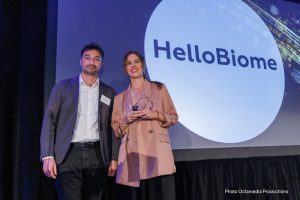 Initially, my network was mostly American, but I received crucial support from the French when I was fundraising for my startup. Géraldine Le Meur, Odile Roujol, Carlos Diaz, and Pierre Gaubil were among the first investors to believe in my project, while American investors were more hesitant. I think they saw a certain boldness and a desire for change.
Today, I am very connected and involved in the French-American ecosystem in the Bay Area, notably as an Ambassador of La French Tech and a member of the French-American Chamber of Commerce of California SF-LA. These roles allow me to forge enriching ties and connections with this dynamic community of entrepreneurs.
When you’re not working for HelloBiome, what are your favorite activities in San Francisco?
My daily life has changed a lot since becoming a mother. I used to do a lot of yoga to de-stress. I also enjoyed hiking, especially in Marin County, but now it’s a bit more complicated with the kids.
In San Francisco, I enjoy taking my children to playgrounds, especially near Dolores Park. I don’t have much time for myself, as I start my day very early, but I appreciate small outings, like grabbing a coffee or having lunch in Californian or Asian restaurants. My favorite spots include Foreign Cinema, Japantown, and Café Trieste, which reminds me of Europe. I also like the hidden bar The Pawn Shop in the Tenderloin, which has an incredible atmosphere.
Merci, Elsa
Find Elsa Jungman at the conference organized by SheforS.H.E., the international community of French-speaking female leaders, on October 10 at L’Appartement Sézane.


